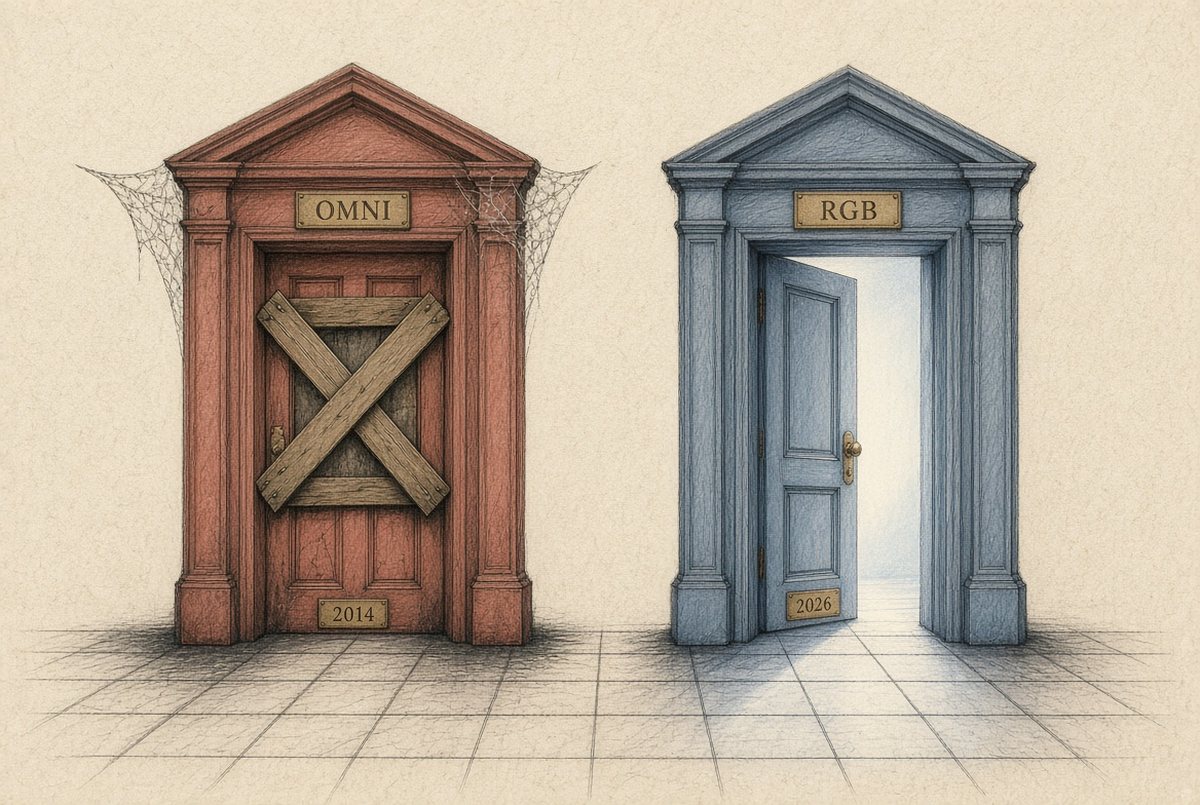
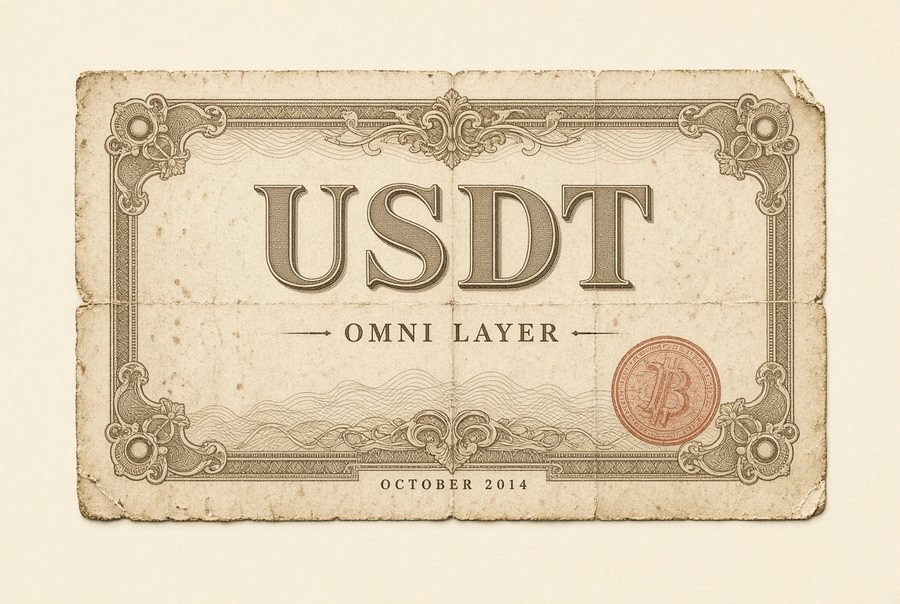
The new layer fixes exactly what broke the old one
Line the two up and the symmetry is almost too neat. Omni died of two things: cost you couldn't predict, and everything being visible. Those aren't incidental complaints - they're the specific reasons a payments business cannot run on a chain, and they're the specific things RGB is built to avoid.
Omni died of unpredictable cost and total visibility. RGB is built against both.
Under Omni, the transfer was the data: an ordinary Bitcoin transaction carrying the asset's details, paying for its bytes at whatever the mempool charged that hour. Under RGB, only a commitment reaches the chain; the transfer itself is validated client-side by the parties involved, and Utexo's layer quotes a fixed fee in USDT rather than an auction in sats.
Which makes the 2023 exit read differently in hindsight. Tether didn't say Bitcoin was the wrong place for a dollar. It said nobody was using this particular way of putting one there - and then named the protocol it was waiting on.
There is a consequence that comes with the repair, and it's worth naming. Because RGB assets are anchored to Bitcoin UTXOs rather than account balances, nobody can freeze a specific holding the way an issuer freezes an Ethereum address; the described approach is a blacklist of associated UTXOs instead. The property that makes the transfer private is the same one that makes it awkward to police. That isn't a flaw in the design - it is the design, and the trade it asks you to accept.
One door, and Tether is holding both keys
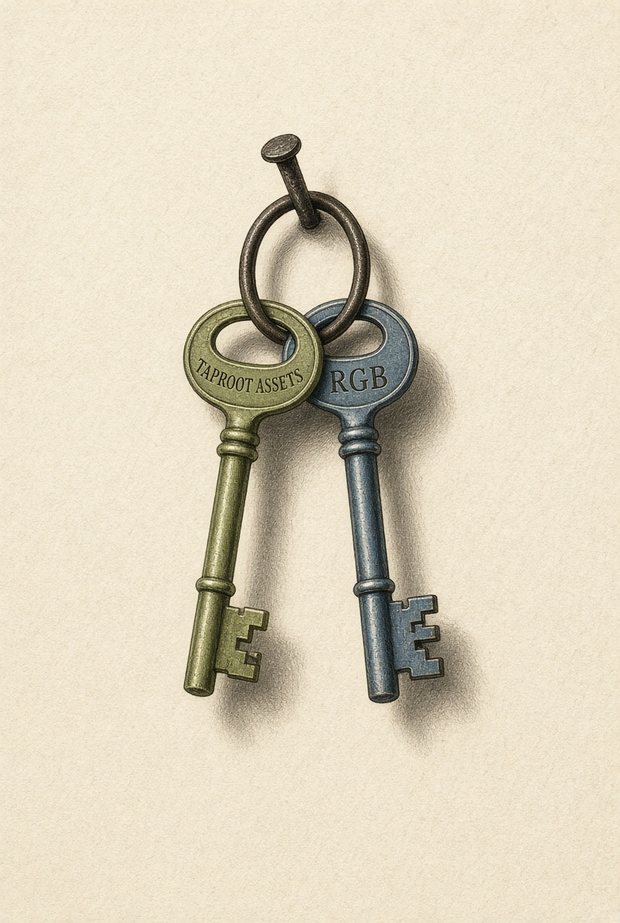
Here is the part that gets flattened in the coverage: there isn't one route back. There are two, they are separate technologies, and Tether has a hand in each.
Same issuer. Same destination. Two standards that don't speak to each other.
The first is Taproot Assets - Lightning Labs' protocol, announced with Tether on stage in El Salvador in January 2025. The second is RGB, which is what Utexo is building on, and where Tether is lead investor in the seed round and has shipped Utexo's Lightning module inside its own Wallet Development Kit. Same issuer, same stated destination, two different standards for getting there.
That isn't necessarily a contradiction - an issuer hedging across two implementations is rational when neither has users yet. But it does set up the question worth watching: if both survive, a dollar on Bitcoin fragments into two incompatible pools, and the liquidity that left for Ethereum because it was cheaper and deeper does not come back to a place that is split in half. Somebody's wallet integration decides this, not a press release.
What would actually count as coming home
For weeks the phrase was doing all the work on its own. A CEO repeated a direction. A meeting in Washington was described by one of the two parties present, with no confirmed mandate on the other side. A team went to a conference in Singapore. Each of those was real; none of them was a dollar arriving in anybody's wallet.
The licence is the hard part. The month is the easy part.
What changed on 2 October is narrower and much harder to wave away: a commercial licence from Tether to issue USDT on Bitcoin, and a stated month. A licence is the part that can't be enthusiasm - it is either granted or it isn't. The month is the softer half; dates in this industry have moved before, and the window named for late summer came and went in September without a consumer release.
So the test from No. 11 still stands, just one step further along: not whether it exists, but how many places you already keep money can hold it. Watch the wallets - UniSat was named as the first - and watch what the three stated uses actually look like in practice, because swaps and BTC-backed lending are a different animal from payments.
The honest version of the story is better than the slogan anyway. A dollar was born on Bitcoin, was pushed off it by the cost of being there, spent nine years somewhere cheaper, and is now walking back in through a layer designed around the exact failure that evicted it - this time with the paperwork to do it.